What is OEKO-TEX® STANDARD 100?
It is a label for textiles — including threads, tapes, elastic and other trims — that have been tested by an OEKO-TEX institute against a catalogue of regulated and non-regulated harmful substances. Certificates are issued for a defined scope of products and must be renewed each year.
The test limits depend on the product class:
| Class | Covers |
|---|---|
| I | Articles for babies and toddlers up to 3 years — the strictest limits |
| II | Articles with direct skin contact (underwear, shirts, waistbands) |
| III | Articles with little or no skin contact (jackets, linings) |
| IV | Decoration materials |
A trim certified in Class I can be used in garments of every class.
What does GRS certify?
The Global Recycled Standard, owned by Textile Exchange, verifies the recycled content of a product and the chain of custody from recycler to finished goods, together with social, environmental and chemical requirements at each certified site. Each certified site has a TE-ID, and shipments of GRS goods can be covered by a transaction certificate.
Recycled polyester (often called rPET) is usually made from post-consumer PET bottles that are cleaned, chipped and re-spun into yarn. A GRS certificate on the trim maker means the recycled claim can be traced — but it applies only to the products and sites named on the certificate.
How do I check a supplier's certificate?
- Ask for the certificate number and the certificate PDF.
- Check the holder name — is it the factory that actually makes your trims?
- Check the scope — which product types are covered, and in which class.
- Check the valid-until date.
- Enter the number on the issuer's site (OEKO-TEX Label Check, or the Textile Exchange database for GRS).
Which certificates does KAYA hold?
Both certificates are held by our own weaving factory in Dongguan:
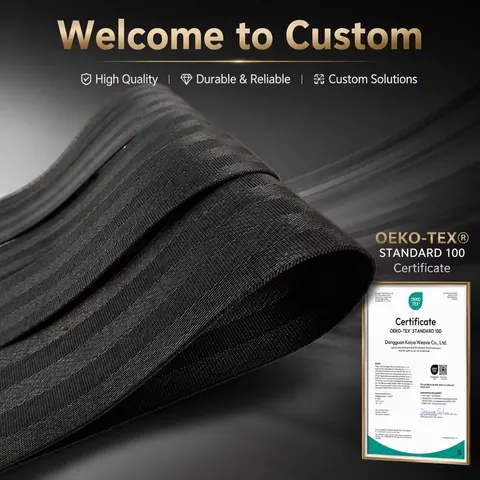
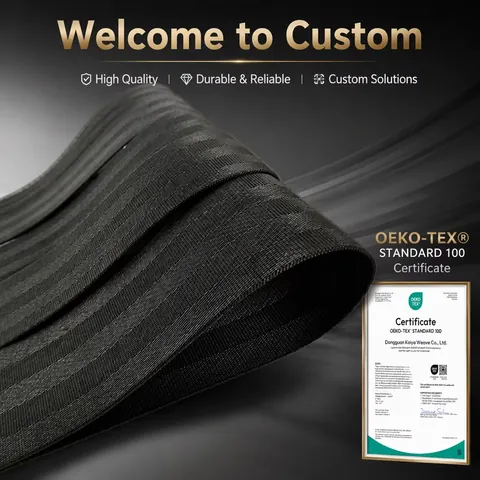
- OEKO-TEX® STANDARD 100 — No. 25.HCN.16447, valid until 30 April 2027. Scope: Tape, cord, lace tape, drawcord, elastic and non-elastic band (polyester / polyamide), Product Class I.
- Global Recycled Standard (GRS) — No. SGC-GRC11660-GRS-2026-09, valid until 10 September 2027. Scope: Functional accessories (PC0017).
The OEKO-TEX scope covers tape, cord, lace tape, drawcord and elastic and non-elastic band. Buttons, zippers and metal or plastic hardware are outside that scope. Details and PDFs are on our certificates page.
Quick answers
Does OEKO-TEX mean a product is organic or recycled?
No. STANDARD 100 is about tested limits for harmful substances. Organic and recycled content are certified by other standards, such as GRS for recycled content.
Do certificates expire?
Yes. OEKO-TEX STANDARD 100 certificates are renewed yearly and GRS certificates have their own validity date, so always check the valid-until date on the certificate.
Last reviewed 2026-11-16 · Related ranges: Elastic Bands · Webbing & Ribbon · Cords & Drawstrings